
Most organizations that have employees working at height invest significant time and resources into fall protection. Workers receive training from a competent person, harnesses and lanyards are issued, and leadership reinforces the importance of tying off whenever work is performed above OSHA's trigger heights, 4 feet in general industry and 6 feet in construction.
These are all essential components of a strong fall protection program.
However, one of the most critical and often misunderstood aspects of fall protection is fall clearance. Even when workers are properly tied off, they can still strike the ground or another lower-level obstruction if adequate fall clearance has not been considered.
What Is Fall Clearance?
Fall clearance is the minimum vertical distance required for a personal fall arrest system to safely stop a worker before they contact the ground, a lower level, or an obstruction such as machinery.
Many workers assume that if they're connected to an anchor point, they're protected. In reality, a fall arrest system requires enough distance to fully deploy and safely absorb the forces generated during a fall. If that distance isn't available, the worker may still strike the surface below despite wearing the proper equipment.
Key Components of Fall Clearance
Many safety professionals have encountered this scenario in the workplace. A worker using a 6-foot shock-absorbing lanyard is working from a platform 13 feet above the lower level. Since the worker is approximately 6 feet tall and the lanyard is 6 feet long, it's easy to assume there is enough clearance to prevent them from striking the ground in the event of a fall.
However, fall clearance isn't that simple. Calculating it requires accounting for several variables, including:
- Free Fall Distance: The distance a worker falls before the fall arrest system begins to engage. This depends on the lanyard length, and the attachment point relative to the harness D-ring.
- Deceleration Distance: The additional distance the shock absorber elongates, or tears open to dissipate energy and stop the fall. OSHA caps this at 3.5 feet for standard lanyards, and 2.5 feet for self-retracting lifelines (SRLs).
- Harness Stretch (D-Ring Slide): The distance the safety harness shifts and stretches during a fall. This includes the upward movement of the back D-ring and the stretching of the webbing, typically estimated at 1 foot.
- Height of the Worker: The distance from the worker's harness D-ring to their feet, generally standardized at 6 feet.
- Safety Factor: An “extra cushion” of distance added to account for variables like rope stretch, dynamic sag, or miscalculations. This is typically a minimum of 2 feet.
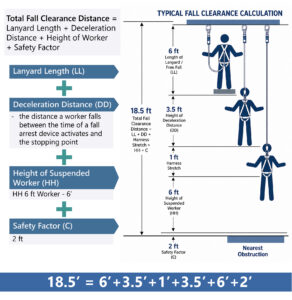
Required fall clearance (FC) can be calculated using the following standard formula:
FC = Free Fall Distance+ Deceleration Distance+ Harness Stretch+ Worker Height+ Safety Factor
For a standard 6-foot shock-absorbing lanyard attached to an overhead anchor, the calculation could look like this:
6 ft (Lanyard/Free Fall) + 3.5 ft (Deceleration) + 1 ft (Harness Stretch) + 6 ft (Worker Height) + 2 ft (Safety Factor) = 18.5 feet of required clearance.
This means a worker’s anchor point must be at least 18.5 feet above the lower surface (or other structure) when using a standard 6-foot lanyard.
When an SRL is utilized, this number decreases greatly:
2 ft (free fall) + 2.5 ft (deceleration) + 1 ft (harness stretch) + 6 ft worker + 2 ft (safety factor) = 13.5 feet of required clearance.
Why Self-Retracting Lifelines Matter
SRLs can significantly reduce the required fall clearance because they lock quickly, often limiting free fall to less than 2 feet. Compared to a standard shock-absorbing lanyard, an SRL typically reduces the required fall clearance to approximately 13.5 feet. That difference can be critical in facilities where available clearance is limited.
SRLs also help reduce trip hazards associated with longer lanyards by keeping the lifeline taut. This is particularly beneficial when workers are climbing ladders or moving through elevated work areas.
While SRLs aren't the right solution for every application, understanding how different fall protection systems affect required clearance is an important part of selecting the appropriate equipment.
Other Hidden Risks
Adequate fall clearance is only one part of a comprehensive fall protection program. Several additional hazards should also be considered:
Swing Falls: When an anchor point cannot be positioned directly overhead, a vertical fall can quickly become a pendulum-like swing fall, increasing the risk of striking nearby structures. Whenever possible, anchor points should remain within approximately 15 degrees of the worker's vertical position, and shorter connecting devices should be used where appropriate.
Horizontal Lifeline Deflection: Horizontal lifeline systems introduce another important consideration.
During a fall, the lifeline deflects downward into a V-shape. While this helps absorb energy and reduce arrest forces, it also increases the total fall clearance required. The longer the horizontal lifeline, the greater the deflection. Workers using horizontal lifeline systems should understand this additional clearance requirement, and competent persons should account for lifeline deflection during system design and fall clearance calculations and opt for SRLs when feasible.
Unsuitable Anchor Points: Per OSHA, fall arrest anchor points must be capable of withstanding 5,000 pounds of force per attached worker (or 2 times the maximum arrest force). This means that handrail, electrical conduit, PVC piping, sprinkler lines, roof vents, and even improperly supported steel piping should not be used.
Training Makes the Difference
A fall protection system is only as effective as the planning behind it. Workers should understand not only how to properly wear and inspect their equipment, but also why fall clearance, anchor point selection, and system design matter. OSHA requires fall protection training to be provided by a competent or qualified person, helping ensure workers can recognize hazards and understand the limitations of the equipment they use. Taking the time to evaluate fall hazards before work begins can mean the difference between a successful fall arrest and a serious injury.
How EnSafe Can Help
EnSafe's health and safety professionals help organizations develop practical, compliant fall protection programs that protect workers while supporting operational needs. We can conduct detailed fall hazard assessments at your workplace, provide fall protection training for your employees, and train your personnel to serve as Competent Persons.
Whether you're implementing a new program or evaluating an existing one, EnSafe can help ensure your fall protection systems are designed to perform when they're needed most.